
Is the tide turning on capital investment in Canada?

 Canada is facing a serious productivity problem, and a lack of business capital investment of often mentioned as one key contributing factor.
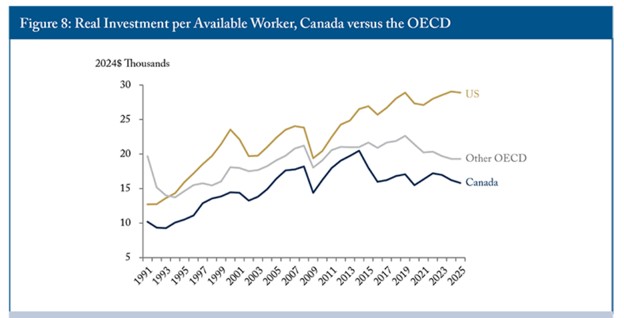
The graphic below – from a C.D. Howe Institute report, illustrates the real investment per available worker in Canada, the U.S. and other Organisation for Economic Co-operation and Development (OECD) countries since 1991.
Oddly enough, since 1972 Canada’s gross fixed capital formation has mostly been higher than the U.S. as a percentage of GDP. This is shown in the graphic below, from a Fraser Institute report.
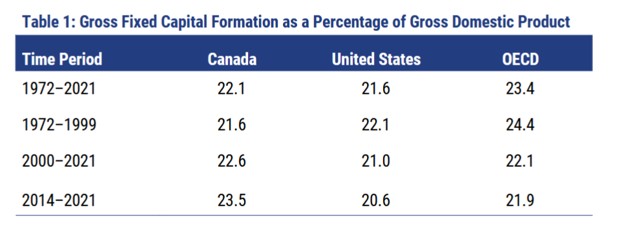
According to the OECD, Gross Fixed Capital Formation (GFCF) measures the value of acquisitions of new or existing fixed assets – such as machinery, buildings and software – by businesses, governments and households, minus disposals. It represents investment in long-term productive capacity rather than consumption.
So where has all that capital gone? The answer is provided by another chart from the same Fraser institute report, below, showing the much higher spending on residential construction in Canada that the U.S.
In the period 2014-2021 Canadian spending on dwellings was 84 percent higher than in the U.S., as a percentage of GDP.
A consequence of this is that much less capital is available for business investment.
So, if Canada isn’t spending enough, wouldn’t foreign direct investment (FDI) fill the gap?
In 2025, Foreign Direct Investment in Canada was $96.8 billion, the highest level since 2007 and an increase of 12 percent from the previous year. This was largely due to Canada’s reputation for political stability.
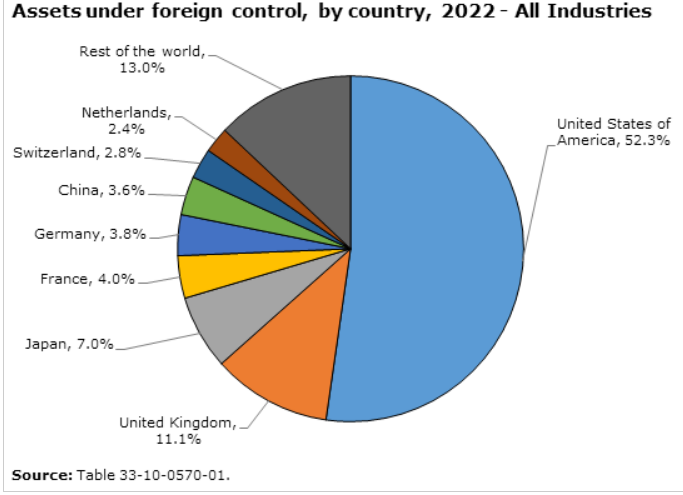
This FDI is approximately equal to 13 percent of the Gross Fixed Capital Formation in Canada in 2025. The U.S. was the largest investor, followed by the U.K., Japan, Germany and China.
However, almost half of the FDI – $43.6 billion – was due to mergers and acquisitions where foreigners bought Canadian companies, so this didn’t contribute to productive investment in Canada.
Whether this is a good thing or a bad thing is debatable. If dividends flow to a foreign owner, it is a loss for Canada.
However, foreign investment can sometimes help a Canadian company grow. If the foreign owner moves the company out of Canada, that is a major loss
What’s new?
According to a survey by the Global Infrastructure Investor Association’s, done in January 2026, before the U.S.-Iran conflict, Canada ranked as the most attractive market for infrastructure investors globally, ahead of the U.S., Germany, Mexico and other countries. It is very likely that Canada is even more attractive now due to its natural resources.
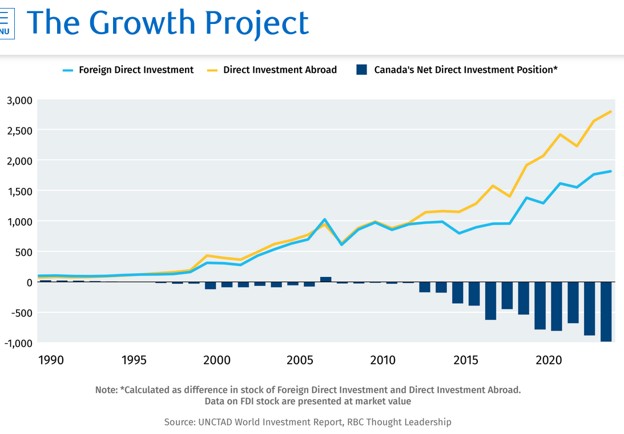
However, according to analysis from the Royal Bank, over the past decade, Canada’s net outflow of investment exceeded $1 trillion, the most significant capital exodus in modern Canadian history.
Also, Canada now ranks last among G7 nations in investment in both machinery and equipment and intellectual property. Only about 30 percent of Canadian capital formation goes into these productivity-enhancing categories – half the U.S. share.
As shown in the graph below, Canada’s direct investment abroad has greatly exceeded foreign direct investment, giving rise to a $1-trillion deficit.
However, RBC Thought Leadership sees an opportunity for reversing this trend and see potential for a $1.8 trillion investment opportunity over the next 10 years could make Canada the G7’s growth leader. Major elements of this are:
- Oil and gas – $705 billion.
- Electricity – $670 billion.
- Agriculture and food processing – $205 billion.
- Metals and minerals – $200 billion.
- Defence – $19 billion.
- Space – $12 billion.
Conclusion
The bad news is that Canada has the lowest spending on machinery and equipment in the G7, and over the last decade net outflow on investment exceeded foreign direct investment by $1 trillion.
The good news is that the tide appears to be turning, and Canada is seen as a very attractive place or foreign investors, and domestic policy is oriented strongly towards increased capital spending with creation of the Major Projects office and a sovereign wealth fund.
The federal government is hoping to attract significant foreign investment at this week’s Canada Investment Summit.
Also, the government is investing millions of dollars to building Major Projects, new infrastructure, and defence and national security, and is looking for foreign investment in these initiatives.
A new report by CPP Investments Insights Institute found that Canada ranks first among eight advanced economies for global investors’ intentions to maintain or increase their allocations.
There is potential for Canada to be a growth leader in the G7 with capital spending of $1.8 trillion over the next decade.
R$
| Organizations: | |
| People: | |
| Topics: |



Events For Leaders in
Science, Tech, Innovation, and Policy
Discuss and learn from those in the know at our virtual and in-person events.
See Upcoming Events
You have 0 free articles remaining.
Don't miss out - start your free trial today.
Start your FREE trial Already a member? Log in
By using this website, you agree to our use of cookies. We use cookies to provide you with a great experience and to help our website run effectively in accordance with our Privacy Policy and Terms of Service.